Problem Formulation
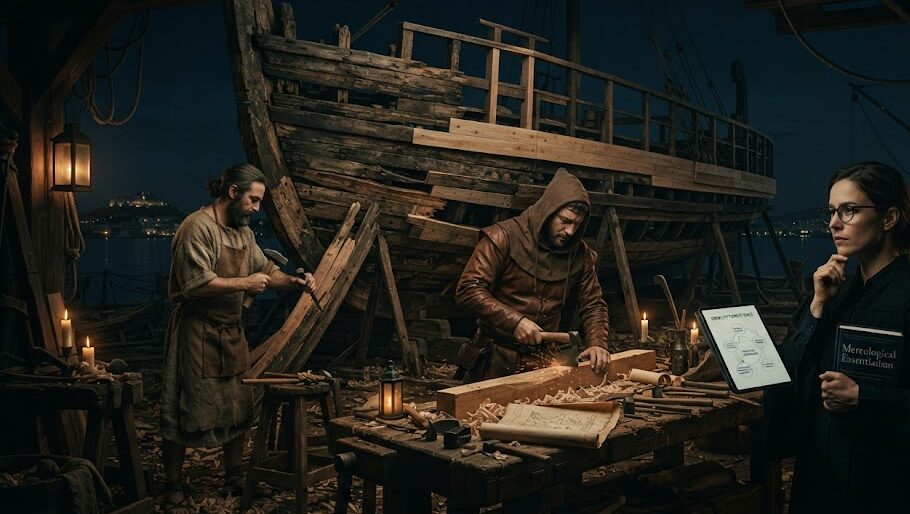
A wooden naval vessel departs port. Over a multi-year voyage, each decaying plank, sail, and nail is systematically replaced with an identical new component until zero original matter remains. Simultaneously, a scavenger collects the discarded original parts and reassembles them into a completed ship. Upon arrival, two physical vessels exist. Which vessel is the genuine, historical Ship of Theseus?
1. Mereology and the Formal Problem of Identity
The Ship of Theseus, documented by Greek biographer Plutarch in the life of Theseus, is not merely an intuitive thought puzzle; it is the canonical stress-test for mereology—the formal mathematical study of parts and wholes. In classical first-order logic with identity, Leibniz’s Law (the Identity of Indiscernibles) dictates that for any entities $x$ and $y$:
$$\forall x \forall y \left[ (x = y) \iff \forall P (P(x) \iff P(y)) \right]$$
If object $x$ is identical to object $y$, every property $P$ true of $x$ must be true of $y$. Yet physical objects exist across temporal intervals $t_1, t_2, \dots, t_n$. When timber plank $\pi_1$ at time $t_0$ is replaced with timber plank $\pi_2$ at time $t_1$, the material constitution property of the ship changes. If material constitution is an essential property, then by strict Leibnizian identity, $\text{Ship}(t_0) \neq \text{Ship}(t_1)$. This paradox exposes the friction between human cognitive categorization and formal ontological persistence.
2. Mereological Essentialism vs. Functional Spatiotemporal Continuity
Philosophers bifurcate into distinct metaphysical camps when formalizing this dilemma:
Mereological Essentialism, championed by Roderick Chisholm, argues that an object’s parts are essential to its identity. If set $S = \{p_1, p_2, \dots, p_n\}$ constitutes object $O$, any subtraction or substitution yields a mathematically distinct entity $O’$. Under this rigid ontology, the Ship of Theseus ceased to exist the exact instant the first nail was replaced.
Conversely, Spatiotemporal Continuity prioritizes the unbroken trajectory of an object through spacetime coordinates. Even if matter turns over 100%, the continuous world-tube in four-dimensional Minkowski space preserves identity because there is no discrete temporal discontinuity. However, Thomas Hobbes introduced the critical flaw in spatiotemporal continuity by adding the reassembled ship: the reassembled ship possesses 100% of the historical matter, while the repaired ship possesses spatiotemporal historical continuity. We now have two competing criteria for identity claiming a single historical antecedent.
3. Four-Dimensionalism and Worm Theory (Perdurantism)
Modern analytic metaphysics addresses this contradiction via Four-Dimensionalism (Perdurantism). In standard three-dimensionalism (Endurantism), objects are wholly present at every instant of their existence. When changes occur, identity across time becomes paradoxical.
Perdurantism redefines objects not as three-dimensional solids moving through time, but as extended four-dimensional spacetime worms (spatiotemporal regions). Under David Lewis’s Worm Theory, what we call ‘The Ship of Theseus’ is a four-dimensional manifold composed of temporal slices (stages):
$$\mathcal{O}_{4D} = \bigcup_{t \in [t_0, t_n]} O(t)$$
Under this topological formulation, the original ship, the continuously repaired ship, and the reassembled ship share temporal parts at $t_0$. Just as two roads can merge and share an identical physical segment of asphalt without being the same highway, the two ships are distinct four-dimensional objects that overlappingly share an initial temporal stage at time $t_0$. Identity is preserved without contradiction because identity is a relation across four dimensions.
4. Formal Set-Theoretic Identity Breakdown Matrix
The following matrix breaks down the analytical evaluations under competing metaphysical frameworks:
| Framework | Claimed Identical Vessel | Core Mathematical Criterion | Handling of Reassembled Ship | Core Philosophical Weakness |
|---|---|---|---|---|
| Mereological Essentialism | Reassembled Ship | Exact material part composition | True continuation of original matter | Rejects incremental repair of all objects |
| Spatiotemporal Continuity | Repaired Sailing Ship | Unbroken worldline in 4D spacetime | Classified as an entirely new artifact | Fails to explain matter preservation rights |
| Perdurantism (4D Worms) | Both (Overlapping stages) | Four-dimensional spatiotemporal manifolds | Divergent branch sharing initial temporal slice | Counterintuitive to common-sense endurantism |
| Informational Functionalism | Repaired Sailing Ship | Topological state and functional invariance | Material artifact devoid of continuous function | Reduces physical identity to informational abstraction |
5. Cellular Turnover and the Neuro-Cognitive Analogy
The Ship of Theseus is not an abstract naval exercise; it is the foundational biological reality of the human organism. Human red blood cells turn over every 120 days; skin epidermal cells replace themselves every 2 to 4 weeks; virtually the entire skeletal matrix is reconstructed over a decade.
Only certain cerebral cortical neurons and cardiac myocytes endure from birth to death, yet even their internal molecular proteins and lipid membranes undergo continuous metabolic turnover. If identity required strict material continuity, human conscious identity would be an illusion lasting only weeks. Cognitive science and philosophy of mind resolve this through pattern continuity (informational functionalism): identity resides not in the substrate molecules, but in the topological information structure (the connectome, synaptic weight matrices, and episodic memory persistence).
6. Computational Systems and Digital Identity
In contemporary software architecture, the Ship of Theseus manifests in distributed computing, rolling server updates, and container orchestration (Kubernetes). When a microservices cluster terminates pod $A$ and replaces it with container $B$ containing identical state configuration, does the cluster maintain transactional identity?
Computer science resolves this through cryptographic hashing and state abstraction: identity is an invariant mathematical relation defined over functional interfaces rather than hardware components. The paradox dissolves when we recognize that ‘identity’ is not a physical substance residing in timber or silicon, but a formal equivalence relation $\sim$ evaluated against explicitly designated systemic invariants.
7. Mereological Fusion and General Extensional Mereology (GEM)
In formal ontology, General Extensional Mereology (GEM) provides an axiomatic foundation for part-whole relationships through the fundamental binary relation of parthood, denoted $P(x, y)$ (“$x$ is a part of $y$”). Parthood is axiomatized as a partial order possessing reflexivity, antisymmetry, and transitivity:
- Reflexivity: $\forall x \, P(x, x)$
- Antisymmetry: $\forall x \forall y \, [P(x, y) \wedge P(y, x) \implies x = y]$
- Transitivity: $\forall x \forall y \forall z \, [P(x, y) \wedge P(y, z) \implies P(x, z)]$
To analyze the Ship of Theseus, GEM introduces the Unrestricted Mereological Fusion Axiom: for any non-empty predicate or set of entities $\mathcal{S}$, there exists an entity $z$ that is the mereological sum (fusion) of $\mathcal{S}$. Under unrestricted composition, the universe contains not merely the original ship and the reassembled ship, but an astronomical array of overlapping mereological fusions—including arbitrary combinations of old timber, new timber, and surrounding seawater. The paradox is not an ontological crisis in physical reality, but a semantic dispute over which specific fusion human language labels as ‘Theseus’.
8. Sortal Concepts and Geach’s Relative Identity
British logician Peter Geach introduced the doctrine of Relative Identity, challenging the classical assumption of absolute identity. Geach posited that identity statements are meaningless without an accompanying sortal concept $F$. Instead of asking whether $x = y$ in absolute terms, formal logic must ask whether $x$ is the same $F$ as $y$ (denoted $x =_F y$):
\text{Ship}_{repaired} =_{\text{ship}} \text{Ship}_{original} \quad \text{but} \quad \text{Ship}_{reassembled} =_{\text{collection of timber}} \text{Ship}_{original}
Under Geach’s relative identity, both ships maintain a legitimate equivalence relation to the historical antecedent, but under mutually distinct sortal criteria. The conflict evaporates when the sortal qualifiers are rendered mathematically explicit.
9. Category Theory and Sheaf-Theoretic Formulations of Identity
In modern mathematical philosophy, the limits of mereological essentialism can be overcome by modeling physical artifacts using Category Theory and sheaf theory. Instead of treating the Ship of Theseus as an invariant static set of physical points, category theory models the ship as a functor $\mathcal{F}: \mathbf{Time} \to \mathbf{Objects}$, where each temporal point $t$ maps to a particular physical realization $\mathcal{F}(t)$, and the transition maps $\mathcal{F}(t_1 \to t_2)$ represent morphisms preserving operational morphology and legal navigational title.
When the original planks are reassembled in a separate drydock, the category experiences a non-trivial colimit bifurcation. We obtain two competing natural transformations: one tracking physical matter continuity (the reconstructed timber hull), and the other tracking continuous structural function (the seaworthy active vessel). In categorical terms, identity over time is not an intrinsic scalar property, but an equivalence class of morphisms within an observation context. Hence, whether a modern warship, a computer program refactored line by line, or a human brain whose neurotransmitters are completely replaced over seven years remains the “same” entity depends entirely upon which semantic morphism the observer evaluates.