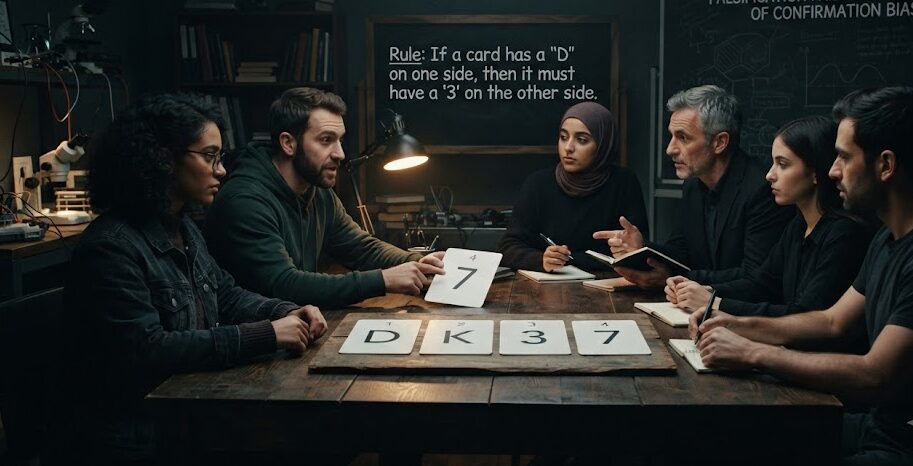
The Four-Card Conditional Rule
Four cards lie on a table. Each card has a letter on one side and a number on the reverse. The visible faces display: [A], [K], [4], and [7]. Test the conditional hypothesis: “If a card has a vowel on one side, then it has an even number on the other side.” Which card or cards must you turn over to determine conclusively whether the rule is true or false? Less than 10% of university students answer correctly. What is the formal logical proof?
Devised in 1966 by British cognitive psychologist Peter Cathcart Wason, the Wason Selection Task is the most famous experimental demonstration of human confirmation bias and the systemic failure of instinctive Popperian falsification in deductive reasoning.
1. Formal Propositional Logic: Modus Ponens and Modus Tollens
To analyze the four-card selection task mathematically, we map the rule onto classical first-order conditional logic:
P \implies Q
Where:
- $P$ is the antecedent: “The card has a vowel on one side.”
- $Q$ is the consequent: “The card has an even number on the reverse side.”
In standard Boolean truth tables, the material implication $P \implies Q$ is logically equivalent to $\neg P \vee Q$. It is false under exactly one configuration: when the antecedent is true and the consequent is false ($P \wedge \neg Q$). Under all other truth valuations, the proposition holds true.
Let us evaluate each of the four cards systematically:
- Card [A] ($P = \text{True}$): Turning [A] tests for Modus Ponens. If the reverse reveals an odd number ($
eg Q$), the rule is instantly falsified. Card [A] must be turned. - Card [K] ($P = \text{False}$): Turning [K] tests a consonant. The rule states: “If vowel, then even.” It makes zero claims regarding consonants! Whether [K] has an even or odd number on the reverse, $P \implies Q$ remains vacuously true. Turning [K] yields zero testing utility.
- Card [4] ($Q = \text{True}$): Turning [4] tests the consequent. If [4] has a vowel, it confirms the rule. But what if [4] has a consonant? The rule does not prohibit consonants from having even numbers! (Affirming the Consequent fallacy). Turning [4] cannot falsify the rule under any outcome.
- Card [7] ($Q = \text{False}$, i.e., $
eg Q$): Turning [7] tests Modus Tollens ($(
eg Q \implies \neg P)$). If [7] has a vowel on the other side, we have an instance of $P \wedge \neg Q$, which completely destroys the hypothesis! Card [7] must be turned.
The strictly necessary and sufficient cards to turn are [A] and [7].
2. Empirical Response Matrix vs. Logical Validity
The scenario matrix below contrasts human intuition against formal mathematical validity across decades of experimental replications:
| Card Inspected | Logical Category | Potential Outcome if Turned | Can It Falsify \(P \implies Q\)? | Human Selection Frequency |
|---|---|---|---|---|
| [A] | Antecedent (\(P\)) | Even (True) / Odd (Falsifies!) | YES (Modus Ponens) | ~90% (Selected correctly) |
| [K] | Negated Antecedent (\( eg P\)) |
Irrelevant (Vacuously true) | NO | ~5% (Ignored correctly) |
| [4] | Consequent (\(Q\)) | Vowel / Consonant (Non-falsifying) | NO (Affirming the Consequent) | ~65% (Fatal Error!) |
| [7] | Negated Consequent (\( eg Q\)) |
Vowel (Falsifies!) / Consonant | YES (Modus Tollens) | ~15% (Tragically Ignored!) |
3. Confirmation Bias and the Asymmetry of Verification
Why do over 80% of intelligent subjects select cards [A] and [4]? In cognitive psychology, this phenomenon exemplifies the verification heuristic (confirmation bias): human beings instinctively seek confirming evidence rather than disconfirming falsification.
Karl Popper argued that scientific hypotheses can never be inductively proven; they can only be corroborated through failed attempts at empirical falsification. Yet human cognitive architecture is reflexively biased toward accumulating positive matches. When subjects see card [4], they imagine a vowel on the reverse and feel a dopamine hit of verification. They fail to recognize that verification carries zero diagnostic value in the presence of material implication.
4. Evolutionary Psychology: Cosmides’ Social Contract Theory
In 1992, evolutionary psychologists Leda Cosmides and John Tooby discovered an extraordinary anomaly. When the identical abstract logical structure is mapped onto a social contract, success rates skyrocket from under 10% to over 75%!
Consider the thematic isomorphic rule: “If a person is drinking beer, they must be at least 21 years old.”
The four cards display: [Drinking Beer], [Drinking Cola], [Age 25], [Age 16].
Immediately, subjects intuitively turn over:
1. The person drinking beer (to check their age).
2. The 16-year-old (to ensure they are not drinking beer).
Zero subjects make the error of checking the 25-year-old!
Cosmides proved that human intelligence did not evolve as a general-purpose formal logic engine operating on abstract Boolean variables. Instead, human encephalization evolved domain-specific cognitive adaptations for Cheater Detection: calculating social contracts, identifying free-riders, and preventing reciprocal altruism exploitation within ancestral hunter-gatherer bands.
5. Bayesian Hypothesis Testing and Optimal Information Gain
In 1994, cognitive scientists Mike Oaksford and Nick Chater demonstrated that the selection of card [4] is not an irrational failure of logic, but an optimal information-theoretic adaptation under Bayesian environment statistics: the Information Gain (Optimal Data Selection) model.
In natural environments, properties are rare (the ‘rarity assumption’). The probability that a random entity has a vowel is low ($P(P) \approx 0.1$), and the probability that an entity has an even number is also low ($P(Q) \approx 0.1$). Under Bayesian experimental design, an agent selects cards that maximize expected Kullback-Leibler (KL) divergence (information gain) between their prior belief distribution and posterior belief distribution:
I_g(c) = \sum_{y} P(y \mid c) D_{KL}(P(H \mid c, y) \parallel P(H))
Oaksford and Chater proved mathematically that when $P(P)$ and $P(Q)$ are rare, inspecting Card [4] yields significantly higher Shannon information gain than inspecting Card [7]! The human mind is not an inferior deductive engine; it is a superior Bayesian statistical machine adapted to an ecology of scarce positive properties.
6. Neural Correlates: Prefrontal Cortex vs. Ventromedial Activation
Neuroimaging studies using fMRI during the Wason Selection Task reveal distinct anatomical activation profiles depending on whether the task is framed abstractly or socially. Abstract logical framing activates the bilateral parietal cortex and the anterior prefrontal cortex—regions associated with high-metabolic working memory load and deliberate cognitive effort.
Conversely, when the task is framed as a social contract (“Beer and Age”), brain activation shifts immediately to the ventromedial prefrontal cortex (vmPFC) and the left fronto-parietal social cognition network. The brain solves the problem not by constructing formal truth tables, but by querying specialized emotional heuristics for detecting fairness, cheating, and reciprocal norm violation.
9. Information Gain and Bayesian Optimal Data Selection
Why do healthy human minds consistently commit the verification fallacy in abstract logic? Cognitive scientists Mike Oaksford and Nick Chater proposed that subjects in the Wason Selection Task are not failing at propositional calculus; rather, they are behaving as rational Bayesian information maximizers under realistic environmental priors. In the real physical world, properties like “being a raven” and “being black” are exceptionally rare relative to all non-black objects in the universe. Under a probabilistic hypothesis testing model, selecting an instance where the rare antecedent $P$ is true generates exponentially higher expected information gain (measured in Shannon bits) than checking a non-consequent $\neg Q$.
Formal Comparison of Formal Logic vs. Bayesian Information Gain
| Analytical Dimension | Propositional Logic (Popperian) | Bayesian Information Gain (Oaksford & Chater) |
|---|---|---|
| Primary Criterion | Strict falsification ($P \wedge \neg Q$) | Maximization of Kullback-Leibler divergence |
| Prior Probabilities | Ignored (truth values are binary) | Considers event rarity ($P(P) \ll P(\neg P)$) |
| Predicted Card Choice | Card ‘A’ and Card ‘7’ exclusively | Card ‘A’ and Card ‘4’ (Highest expected entropy reduction) |
When the task is shifted to deontic social contracts—such as “If you drink beer, you must be over 21″—the evolutionary utility of detecting cheaters aligns precisely with formal falsification, causing human success rates to soar from 10% to over 75%.
10. Neurocognitive Dynamics: Dual-Process Conflict and Heuristic Override
Modern cognitive neuroscience confirms that falsification requires active, energy-intensive cognitive control. Event-related potential (ERP) studies identify an elevated N200 and error-related negativity (ERN) waveform in the prefrontal cortex whenever subjects consider the counter-intuitive $\neg Q$ card. Unlike everyday inductive pattern-matching, deductive falsification demands the conscious suppression of confirmatory associative networks.
By transforming raw conditional rules into concrete social contracts with well-defined cheater-detection parameters, humans effortlessly recruit evolved modular cognitive architectures. The Wason Selection Task ultimately demonstrates that human rationality is not broken, but organically sculpted for ecological survival rather than scholastic formalisms.