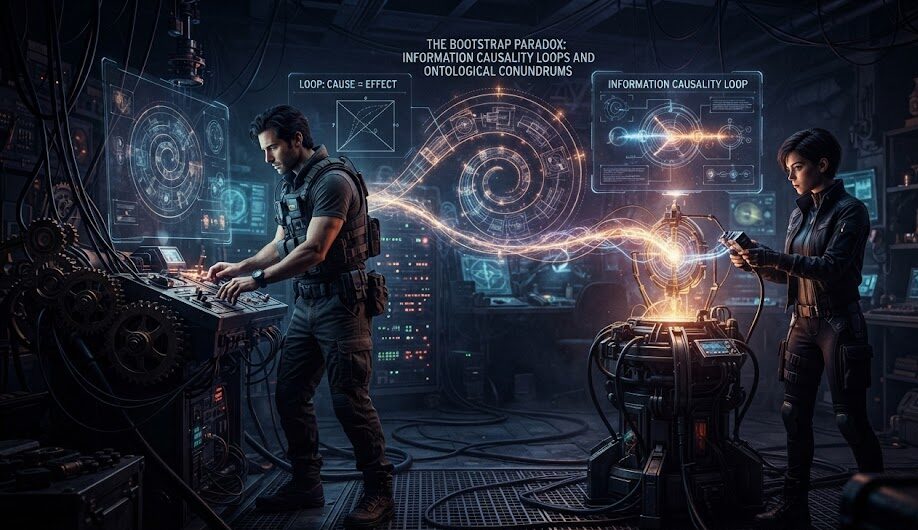
Problem Formulation
A temporal archivist purchases a pristine first-edition copy of Shakespeare’s *Hamlet* from a 21st-century bookstore, travels back to London in 1595, and hands the manuscript directly to William Shakespeare. Shakespeare transcribes the work, publishes it, and centuries later, that exact printed lineage ends up in the bookstore where the archivist purchases it. Who composed *Hamlet*? What is the ontological origin of the information?
1. Ontological Causal Loops vs. The Grandfather Paradox
While the classical Grandfather Paradox involves an inconsistency loop (an event that negates its own causal antecedent), the Bootstrap Paradox (ontological paradox) represents a self-reinforcing causal loop. In a bootstrap loop, every event along the closed path is locally consistent and causally justifiable by the preceding event, yet the global system contains an uncaused information state or object.
Mathematically, let an event space be represented as a directed graph $G = (V, E)$, where vertices $V$ represent physical states at specific spacetime coordinates and directed edges $E$ represent causal arrows determined by forward light cones. In standard Minkowski spacetime, $G$ is a directed acyclic graph (DAG).
In spacetimes with closed timelike curves (such as Gödel or Kerr spacetimes), $G$ contains directed cycles:
$$v_0 \to v_1 \to v_2 \to \dots \to v_n \to v_0$$
Every transition $v_k \to v_{k+1}$ satisfies local conservation laws of momentum, energy, and entropy. However, the origin of the information payload $I(v_0)$ cannot be traced back to an external Cauchy boundary condition. The information has no ontological genealogy.
2. The Conservation of Information and Shannon Entropy
In physical systems, information is not an abstract concept; by Landauer’s Principle, information is physical. The erasure or generation of one bit of information requires a minimum thermodynamic energy dissipation of $E = k_B T \ln(2)$.
Consider the manuscript of *Hamlet* circulating within the loop. As the physical book travels from 1595 to the 21st century, its cellulose fibers accumulate entropic degradation: thermal wear, oxidation, mechanical handling, and UV discoloration. If the identical physical artifact is handed to Shakespeare in 1595, its macroscopic entropy must satisfy:
$$S(t_{return}) > S(t_{departure})$$
By repeated traversal around the cycle, the entropy would accumulate toward infinity ($S \to \infty$), reducing the paper to ash. Therefore, a physical object cannot circulate endlessly through a closed timelike curve without violating the Second Law of Thermodynamics.
However, if Shakespeare transcribes the text by hand onto fresh paper, the physical entropy resets. What circulates is not matter, but pure Shannon information:
$$H(X) = -\sum_{i} P(x_i) \log_2 P(x_i)$$
The paradox shifts from a physical contradiction to an epistemic and algorithmic absurdity: an algorithm containing $130,000$ characters of English prose exists without ever having been computed or generated by a biological mind.
3. Fixed Point Theorems and Algorithmic Information Theory
Algorithmic Information Theory, pioneered by Andrey Kolmogorov and Gregory Chaitin, defines the Kolmogorov complexity $K(s)$ of a string $s$ as the length of the shortest computer program that outputs $s$:
$$K(s) = \min \{ |p| : U(p) = s \}$$
For Shakespeare’s *Hamlet*, $K(s) \gg 10^5$ bits. In standard causal physics, generating high Kolmogorov complexity requires an computational engine (e.g., billions of neural firing operations across years of Shakespeare’s life).
In a bootstrap information loop, the computational cost is zero. The information exists as an unearned eigenstate of the temporal propagation operator $\hat{T}$:
$$\hat{T} |\Psi_{Hamlet}\rangle = |\Psi_{Hamlet}\rangle$$
David Deutsch’s quantum computational model of closed timelike curves demonstrates that quantum systems can find fixed-point eigenstates autonomously. However, algorithmic information theory highlights a severe violation of algorithmic conservation: complex algorithmic structures emerge without mathematical algorithmic work.
4. Comparative Analysis: Causal Loop Archetypes
The following matrix contrasts the primary categories of temporal anomalies encountered in closed timelike geometries:
| Loop Type | Payload Type | Physical Consistency | Thermodynamic Violation | Information Origin |
|---|---|---|---|---|
| Bootstrap Paradox | Pure Information (Text/Data) | Locally consistent, globally uncaused | Zero if transcribed onto new substrate | Undefined (Eigensolution of loop) |
| Physical Matter Loop | Macroscopic Artifact (Watch/Ring) | Inconsistent due to atomic wear | Severe violation of Second Law ($S \to \infty$) | Originates nowhere in past or future |
| Predestination Paradox | Causal Event Sequence | Locally deterministic block universe | None (Complies with entropy gradients) | Initial Big Bang cosmic boundary conditions |
| Gott-Li Cosmic Loop | Spacetime Metric Tensor $g_{\mu\nu}$ | Conforms to Einstein field equations | Planck-scale quantum vacuum inflation | Self-generating temporal topology |
5. The Predestination Paradox and Free Will Invariants
A direct mathematical corollary of the Bootstrap Paradox is the Predestination Paradox. In this scenario, an agent travels to the past specifically to avert a recorded historical catastrophe (e.g., an industrial explosion or a major fire). However, their retrocausal intervention directly triggers the catastrophic event.
In dynamical systems theory, this is modeled as an attractor in phase space. Let $x(t)$ be the state vector of history. The traveler’s actions, intended to deflect the trajectory away from catastrophe point $x^*$, instead act as the restoring force directed exactly toward $x^*$:
$$\frac{dx}{dt} = -\nabla V(x – x^*)$$
The traveler’s perceived counterfactual agency (‘I could have chosen otherwise’) is an epistemic illusion arising from incomplete internal state information. When integrated over the entire 4D manifold, the traveler’s choice was an invariant constituent of the historical record from the initial Big Bang boundary condition.
6. Cosmological Bootstrapping: The Universe as a Self-Excited Circuit
Perhaps the most profound application of the Bootstrap Paradox is in quantum cosmology. In 1998, physicists J. Richard Gott and Li-Xin Li published a paper in *The Astrophysical Journal* proposing that the universe did not originate from an external initial singularity, but created itself through a closed timelike curve at the Planck epoch.
In the Gott-Li model, a small branch of the early inflationary universe loops backward in time, becoming the trunk of the cosmic tree. The universe becomes a self-excited ontological circuit: spacetime creates the conditions for its own emergence. Rather than requiring an uncaused first cause (an external Prime Mover) or an infinite regress, quantum gravity may allow the cosmos to be the ultimate bootstrap paradox—a mathematically consistent, self-originating topological loop.
7. Quantum Information and Wheeler-Feynman Absorber Theory
The formal physics of the Bootstrap Paradox intersects with John Wheeler and Richard Feynman’s Absorber Theory of electrodynamics. Wheeler and Feynman demonstrated that Maxwell’s equations are fundamentally time-symmetric: for every retarded potential traveling forward in time, there exists a mathematically valid advanced potential traveling backward in time.
In Wheeler-Feynman theory, an electromagnetic wave emitted by an antenna does not propagate into passive empty space; it interacts with future absorber particles in the universe. The future absorbers emit advanced waves that travel backward in time, perfectly canceling the advanced waves of the emitter and doubling the retarded wave. Causality appears unidirectional only because the universe satisfies an asymmetry in thermodynamic absorber boundary conditions. In closed timelike geometries, advanced and retarded waves form standing temporal loops, demonstrating that information propagation can be time-symmetric without generating logical contradictions.
8. Topological Solitons and Causal Consistency Algorithms
In computational topology, bootstrap information loops can be modeled as topological solitons—localized, self-reinforcing wave packets that maintain their shape and informational structure through non-linear self-interaction. A soliton circulating around a periodic temporal domain satisfies a non-linear differential eigenvalue problem:
\mathcal{L}[\psi] = \lambda \psi, \quad \text{with boundary condition } \psi(t + T) = \psi(t)
The existence of such solutions proves that within curved spacetime manifolds, information need not possess an external ‘creator’ or Cauchy origin point; it exists as a geometrically permissible eigenstate of the underlying spacetime curvature itself.
9. Topological Quantum Field Theory and Closed Causal Graphs
To mathematically accommodate ontology loops without violating conservation laws, theoretical physicists examine bootstrap paradoxes through Topological Quantum Field Theory (TQFT). In standard flat Minkowski spacetime, quantum state vectors evolve unitarily via the operator $U(t) = \exp(-iHt/\hbar)$, guaranteeing that any state $\lvert \psi(t) \rangle$ depends strictly on prior initial states. However, in non-simply connected spacetimes containing closed causal loops, the global path integral integrates over all non-contractible Wilson loops $\oint A_\mu dx^\mu$.
Under this topological regime, the informational blueprint or manuscript does not have an origin event because the state vector is an eigenstate of the global monodromy matrix $\mathcal{M} \lvert \psi \rangle = \lambda \lvert \psi \rangle$ with eigenvalue $\lambda = 1$. The information is an unremovable topological invariant of the manifold’s global homology group $H_1(\mathcal{M}, \mathbb{Z})$, identical to a topological soliton or vortex that exists as a boundary condition of spacetime itself.