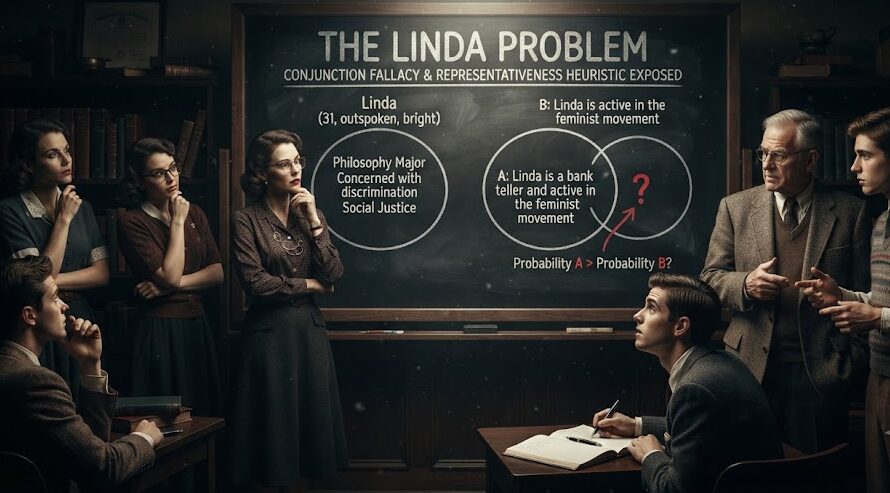
The Conjunction Probability Test
Linda is 31 years old, single, outspoken, and very bright. She majored in philosophy. As a student, she was deeply concerned with issues of discrimination and social justice, and also participated in anti-nuclear demonstrations. Which is more probable?
Option A: Linda is a bank teller.
Option B: Linda is a bank teller and is active in the feminist movement.
Over 85% of subjects, including graduate students with extensive statistical training, choose Option B. What elementary probability axiom makes Option B an impossible answer?
Formulated in 1983 by Nobel laureate Amos Tversky and Daniel Kahneman, the Linda Problem is the quintessential demonstration of the Conjunction Fallacy. It illustrates how the human mind routinely sacrifices basic Kolmogorov probability axioms in favor of narrative coherence and the representativeness heuristic.
1. The Mathematical Axiom: The Monotonicity of Conjunction
In formal probability theory, let the sample space be $\Omega$. Let $A$ and $B$ represent two events (subsets of $\Omega$):
- $A$: The event that Linda is a bank teller.
- $B$: The event that Linda is active in the feminist movement.
Option B represents the logical conjunction (set intersection) of both events: $A \cap B$.
Under Kolmogorov’s third probability axiom, the probability of any event is non-negative, and probabilities over subsets are monotonic. Because the intersection of two sets is a strict subset of each constituent set ($A \cap B \subseteq A$), the joint probability can never exceed the marginal probability of either individual event:
P(A \cap B) \le P(A) \quad ext{and} \quad P(A \cap B) \le P(B)
By conditional probability:
P(A \cap B) = P(A) \cdot P(B \mid A)
Since $P(B \mid A) \le 1$, multiplying $P(A)$ by a probability cannot yield a result strictly greater than $P(A)$. Every feminist bank teller in the world is, by definition, a bank teller. Therefore, it is mathematically impossible for Option B to be more probable than Option A.
2. Set-Theoretic Venn Diagram and Probability Matrix
The scenario matrix below visualizes the set-theoretic relationship and empirical response distribution:
| Hypothesis Option | Set-Theoretic Notation | Subpopulation Encompassed | Relative Mathematical Probability | Empirical Selection Rate |
|---|---|---|---|---|
| Option A | \( A \) | All bank tellers (feminist + non-feminist) | \( P(A) \) (Strictly Greater!) | ~15% |
| Option B | \( A \cap B \) | Only feminist bank tellers | \( P(A \cap B) \le P(A) \) (Smaller subset) | ~85% (Conjunction Fallacy!) |
3. The Representativeness Heuristic: Narrative Coherence vs. Likelihood
Tversky and Kahneman explained that human judgment under uncertainty is governed not by probability calculus, but by heuristic shortcuts. In this case, judgment is dominated by the Representativeness Heuristic: subjective probability is evaluated based on the degree of similarity between an individual profile and a cognitive stereotype.
Linda’s description (philosophy major, social justice advocate, anti-nuclear demonstrator) bears zero typical resemblance to the prototype of a conservative commercial bank teller ($P( ext{Description} \mid ext{Teller}) \approx \text{Low}$). However, her profile matches the prototype of an active feminist with extreme fidelity ($P( ext{Description} \mid ext{Feminist}) \approx \text{High}$).
When subjects evaluate Option B (“Feminist bank teller”), the descriptive archetype activates the feminist attribute, making the compound narrative feel representative, vivid, and plausible. The human brain unconsciously substitutes the difficult question: “What is the statistical probability $P(A \mid D)$?” with the intuitive question: “How closely does Linda resemble the mental image of Option B?”
4. The Extensional vs. Intensional Reasoning Dilemma
The Linda Problem demonstrates the deep clash between Extensional Reasoning (evaluating membership counts and set inclusions) and Intensional Reasoning (evaluating conceptual attributes, features, and plausibility). Modern legal systems, financial risk evaluations, and intelligence agencies are notoriously vulnerable to this fallacy.
Consider risk scenarios: “A major earthquake occurs in California” vs. “A major earthquake in California causes a catastrophic flood that breaches dams.” Forecasters consistently rate the compound scenario as more probable simply because the visual narrative is easier to mentally simulate, directly replicating the Linda conjunction error.
5. Natural Frequency Formulations: Eliminating the Conjunction Illusion
In 1996, psychologist Gerd Gigerenzer demonstrated that the Conjunction Fallacy can be virtually eradicated if probabilistic problems are reformulated from abstract percentages into Natural Frequencies. Instead of asking: “Which statement is more probable?”, researchers presented the problem to subjects in frequency format:
“There are 100 people who fit the description of Linda. How many of them are:
(a) Bank tellers?
(b) Bank tellers who are active in the feminist movement?”
When framed in natural frequencies, the error rate plunged from 85% down to under 15%! In natural frequency space, human minds immediately perceive set inclusion: it is visually and cognitively obvious that a subset of a group cannot contain more physical bodies than the parent group. Human cognitive evolution evolved to process natural counts (frequencies of individuals observed in a tribe) rather than normalized fractions and abstract single-event probabilities.
6. Juridical and Forensic Fallacies: The Prejudicial Hazard
The Linda Problem has devastating real-world ramifications in courtroom jurisprudence. Prosecutors frequently construct complex, highly detailed narrative accounts of a crime. A narrative stating: “The defendant entered the bank, shot the security camera with a suppressed pistol, and stole the jewels” sounds far more plausible and convincing to a jury than the simple charge: “The defendant committed robbery.”
Jurors routinely commit the conjunction fallacy, convicting defendants based on the vivid representativeness of a complex story, unaware that every added detail mathematically reduces the joint probability that the prosecution’s entire narrative is strictly true.
9. Formal Mathematical Proof of the Conjunction Law Violation
To mathematically characterize the magnitude of the fallacy, consider the foundational Kolmogorov axioms of probability theory. Let $(\Omega, \mathcal{F}, P)$ be a well-defined probability space. For any two arbitrary events $A, B \in \mathcal{F}$, the probability of their conjunction satisfies:
P(A \cap B) = P(A) \cdot P(B \mid A) = P(B) \cdot P(A \mid B)Because probabilities are strictly bounded within the closed interval $[0, 1]$, and specifically $P(A \mid B) \le 1$ and $P(B \mid A) \le 1$, the following fundamental monotonic inequalities hold unconditionally:
P(A \cap B) \le P(A) \quad \text{and} \quad P(A \cap B) \le P(B)In the Linda problem, let $T$ represent “Linda is a bank teller” and $F$ represent “Linda is active in the feminist movement.” By axiom, $P(T \cap F) \le P(T)$. Yet in empirical experiments, 85% of subjects rank:
P(T \cap F) > P(T)This creates a strict mathematical impossibility of the form $X > X + \delta$ where $\delta = P(T \cap F^c) \ge 0$.
10. Natural Sampling and the Frequency Format Solution
Evolutionary psychologists Gerd Gigerenzer and Peter Todd demonstrated that human cognitive architecture is not optimized for single-event probabilities expressed as percentages, but for natural frequencies gathered through sequential sensory experience. When the identical scenario is reframed in natural frequency terms, the conjunction fallacy almost entirely disappears:
Natural Frequency Formulation:
“There are 100 women who fit the description of Linda. Out of these 100 women:
(A) How many are bank tellers?
(B) How many are bank tellers and active in the feminist movement?”
When asked to estimate discrete human counts, over 80% of participants immediately recognize that a sub-branch of bank tellers cannot numerically exceed the entire pool of bank tellers. The error rate drops from 85% to below 15%. This proves that the conjunction fallacy is not an incurable defect in reasoning, but a translation breakdown between evolutionary frequency processors and abstract symbolic probabilities.
11. Dual-Process Theory and System 1 Representativeness Traps
Daniel Kahneman and Amos Tversky’s foundational Dual-Process Theory provides the psychological architecture underlying the conjunction fallacy. System 1 operates automatically, associatively, and without voluntary effort, continuously evaluating incoming data against internalized prototypes. When reading Linda’s character sketch, System 1 computes similarity metrics instantly:
\text{Similarity}(\text{Linda}, \text{Feminist Bank Teller}) \gg \text{Similarity}(\text{Linda}, \text{Generic Bank Teller})Because System 1 substitutes the effortless heuristic question “How typical is Linda of this group?” for the complex normative question “What is the mathematical probability of this joint set?”, the mind commits a substitution error. Overcoming this error requires System 2 to intervene, inhibit the salient prototype, and enforce set-theoretic monotonicity. Without conscious statistical training, System 1 intuition reliably overrules mathematical law.