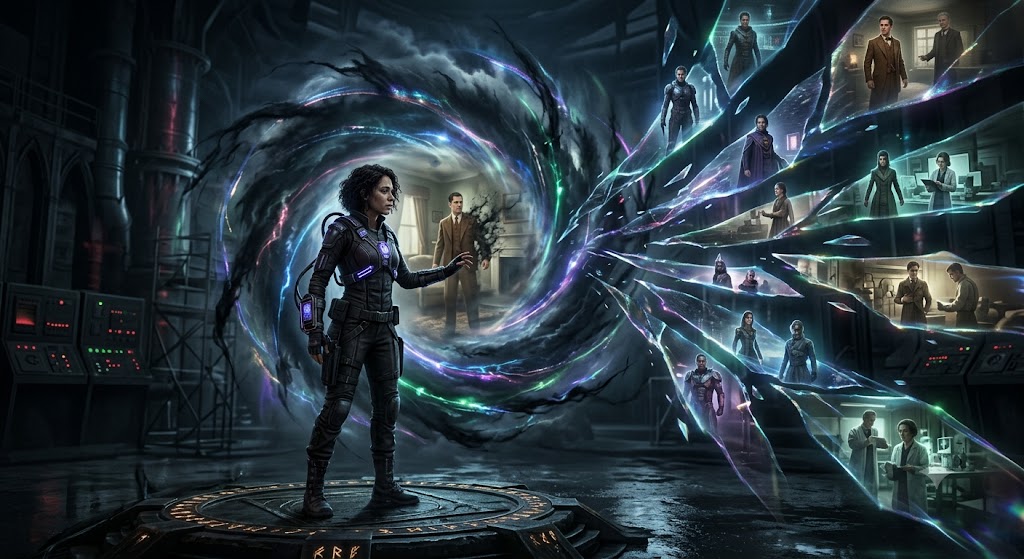
Problem Formulation
A temporal traveler journeys backward along a closed geodesic in spacetime to a temporal coordinate preceding their ancestral conception. The traveler executes an action that precludes the genetic union of their forebears. If the ancestors never conceive, the traveler is never born; if the traveler is never born, no backward traversal occurs to avert conception. Does spacetime permit such retrocausal contradictions?
1. General Relativity and Gödelian Closed Timelike Curves
The grandfather paradox is frequently dismissed as a science-fiction trope, yet in formal differential geometry, it represents an intractable boundary-value enigma. In 1949, Kurt Gödel demonstrated that Albert Einstein’s field equations of General Relativity permit exact cosmological solutions containing closed timelike curves (CTCs). A CTC is a worldline in a Lorentzian manifold wherein a massive particle trajectories along a continuously time-directed path that intersects its own past light cone.
Mathematically, let $(M, g)$ be a four-dimensional spacetime manifold endowed with a pseudo-Riemannian metric $g_{\mu\nu}$ of signature $(-, +, +, +)$. A curve $\gamma: [0, 1] \to M$ is defined as timelike if at every parameter point $\lambda \in [0, 1]$, the tangent four-velocity vector satisfies:
$$g_{\mu\nu} \frac{d\gamma^\mu}{d\lambda} \frac{d\gamma^\nu}{d\lambda} < 0$$
A closed timelike curve occurs when $\gamma(1) = \gamma(0)$ while maintaining continuous local forward orientation along the affine parameter $\lambda$. While Kerr black holes and Tipler cylinders theoretically produce local CTC regions, classical physics stumbles when macroscopic entropy and classical deterministic state vectors $\Psi(t)$ are mapped onto these non-simply connected topologies.
2. The Novikov Self-Consistency Conjecture: Classical Determinism
In the 1980s, astrophysicist Igor Dmitriyevich Novikov formulated a classical resolution based on global variational calculus: the Novikov Self-Consistency Principle. Novikov posited that the laws of physics are strictly local, but the topology of a spacetime manifold containing CTCs imposes global constraints. If an event occurs along a CTC, its probability is not determined by local initial value conditions, but by global topological self-consistency.
Under the Novikov principle, any action that would create an inconsistency (such as averting one’s own birth) has a global probability of exactly zero. Every physical event along the CTC must form a single, uninterrupted, four-dimensional block-universe solution. If a traveler attempts to pull a trigger, quantum fluctuations, mechanical jamming, or unforeseen kinematic perturbations will intervene with absolute certainty. Causality is preserved, but local counterfactual free agency is extinguished.
3. Deutschian Quantum State Vectors: Unitary Operator Solutions
The classical Novikov formulation creates uncomfortable questions regarding why certain macroscopic probabilities drop abruptly to zero. In 1991, physicist David Deutsch provided an alternative framework by mapping closed timelike curves into quantum computational circuits.
Instead of classical trajectories, Deutsch treated the chronological past as a quantum density matrix $\rho$. The interaction between the external chronology-respecting quantum system (state $\rho_{in}$) and the internal CTC system (state $\rho_{ctc}$) is governed by a global unitary evolution operator $U$:
$$\rho_{ctc} = \text{Tr}_{ext} \left( U (\rho_{in} \otimes \rho_{ctc}) U^\dagger \right)$$
Deutsch proved via the Schauder Fixed Point Theorem that for every unitary operator $U$ and every valid initial input state $\rho_{in}$, there exists at least one fixed-point density matrix $\rho_{ctc}$ satisfying this equation. If the traveler attempts to create an contradictory bit-flip (a quantum NOT gate), the fixed point solution settles into a mixed quantum state with eigenvalues of exactly $0.5$. In the Many-Worlds interpretation of Everett, the traveler enters an orthogonal Hilbert subspace: their ancestors in Branch $A$ remain unperturbed, while the traveler alters history exclusively within Branch $B$.
4. Comparative Resolution Matrix across Theoretical Physics
The table below illustrates how competing cosmological and quantum frameworks resolve the causal loop of the Grandfather Paradox:
| Theoretical Framework | Primary Mechanism | Causal Consistency | Multiverse Requirement | Thermodynamic Status |
|---|---|---|---|---|
| Novikov Principle | Global topological variational constraint | Deterministic loop | No (Single Block Universe) | Entropy invariant along closed loop |
| Deutschian Quantum CTC | Density matrix fixed-point theorem | Probabilistic mixed state | Yes (Everettian Branching) | Unitary preservation across branches |
| Hawking Chronology Protection | Quantum stress-energy divergence | CTC prevented by horizon collapse | No | Infinite divergence at Cauchy horizon |
| Consistent Histories | Decoherence functional projection | Non-interfering history families | No | Decohered pointer states preserve arrows |
5. Thermodynamic Entropy and the Hawking Chronology Protection Conjecture
Stephen Hawking was famously skeptical of macro-scale closed timelike curves. In 1992, Hawking formulated the Chronology Protection Conjecture, which states that the laws of quantum field theory in curved spacetime inherently prevent the formation of CTCs.
When quantum vacuum fluctuations are evaluated near the Cauchy horizon—the boundary separating chronology-respecting spacetime from CTC domains—the renormalized stress-energy tensor $\langle T_{\mu\nu} \rangle_{ren}$ diverges toward infinity:
$$\lim_{x \to \mathcal{H}^+(S)} \langle T_{\mu\nu}(x) \rangle_{ren} = \infty$$
This infinite back-reaction generates immense gravitational curvature, destabilizing the wormhole throat or Cauchy horizon before an observer can traverse it. Consequently, nature appears to protect historical chronology not by altering human agency or invoking multiverses, but by violently collapsing the spacetime geometry that would facilitate backward retrocausality.
6. Epistemological and Computational Implications
Beyond theoretical physics, the Grandfather Paradox forces computer scientists and epistemologists to re-examine computational complexity classes. In 2009, Scott Aaronson demonstrated that closed timelike curves governed by Deutschian quantum mechanics would allow computational problems in the complexity class $\text{PSPACE}$ (polynomial space) to be solved in polynomial time ($\text{BQP}_{CTC} = \text{PSPACE}$).
The elimination of causal contradiction through quantum mixed states does not merely prevent temporal absurdity; it fundamentally alters the bounds of mathematical computability, turning intractable combinatorial searches into fixed-point eigenvalue discoveries.
7. Mathematical Formalization of Cauchy Horizons and Chronology Horizons
To mathematically quantify the boundary where standard causality terminates, physicists construct the Cauchy horizon $\mathcal{H}^+(S)$, which represents the future boundary of the domain of dependence $D^+(S)$ of an initial spacelike Cauchy surface $S$. For any point $p$ situated beyond $\mathcal{H}^+(S)$, there exist past-directed inextendible causal curves that never intersect the initial data surface $S$. Consequently, the state at $p$ cannot be predicted from initial conditions on $S$, signaling the complete breakdown of deterministic Laplacian predictability.
In Gödel’s rotating universe, the metric tensor in cylindrical coordinates $(t, r, \phi, z)$ is given by:
ds^2 = -c^2 dt^2 + dr^2 + dz^2 – \frac{r^2}{2} d\phi^2 – 2\sqrt{2} r \, c \, dt \, d\phi
As the radial coordinate $r$ increases beyond the critical threshold $r_c = 2c / \omega$ (where $\omega$ is the cosmological angular rotation velocity), the $g_{\phi\phi}$ metric component becomes strictly negative ($g_{\phi\phi} < 0$). Circles of constant $t, r, z$ transition from spacelike to timelike trajectories! An observer traveling along the coordinate $\phi$ traverses a closed path that loops directly into their own past light cone without encountering infinite curvature or gravitational singularities.
8. Topological Fixed-Point Theorems and the Schauder Principle
David Deutsch’s proof that quantum consistency can resolve the Grandfather Paradox relies on the Schauder Fixed Point Theorem from functional analysis. Let $\mathcal{S}$ denote the convex, compact set of density operators acting on a finite-dimensional Hilbert space $\mathcal{H}$. The mapping $f: \mathcal{S} \to \mathcal{S}$ defined by the partial trace over the external environment:
f(\rho_{ctc}) = \text{Tr}_{ext} \left( U (\rho_{in} \otimes \rho_{ctc}) U^\dagger \right)
is a continuous map of a non-empty, compact, convex subset of a topological vector space into itself. By Schauder’s theorem, $f$ must possess at least one fixed point satisfying $f(\rho^*) = \rho^*$. This mathematical guarantee ensures that nature always possesses an equilibrium state, eliminating the logical paradox by replacing discrete classical contradictions with self-consistent quantum superpositions.
9. Thermodynamic Entropy and Chronological Protection in Quantum Gravity
Beyond macroscopic general relativity, Stephen Hawking’s Chronology Protection Conjecture posits that the fundamental laws of physics actively conspire to prevent closed timelike curves on subatomic scales through vacuum polarization. As quantum field fluctuations propagate near the Cauchy horizon—the boundary beyond which geodesics can loop back into their own past—the stress-energy tensor expectation value $\langle T_{\mu\nu} \rangle$ diverges to infinity. This violent quantum back-reaction warps the local spacetime metric, collapsing the wormhole throat or Cauchy singularity before macroscopic causality violations can manifest.
From an informational perspective, macroscopic retrocausality violates the Generalized Second Law of Thermodynamics (GSL). If an agent transports matter or entropy into an earlier epoch, the total entropy $S_{total} = S_{matter} + \frac{A}{4 G \hbar}$ of the past universe abruptly increases without a corresponding thermodynamic expenditure in the forward light-cone. Thus, nature maintains macroscopic consistency either through rigid quantum decoherence or topological censorship, ensuring the thermodynamic arrow of time remains globally unidirectional.